In Japan, there is a fierce debate below the surface over whether to attempt restart of nuclear power plants after they finish their initial 40-year license terms. Kansai Electric (KEPCO) is the Japanese utility most reliant on nuclear, traditionally, and it has recently announced an intention to seek a license extension for 2 plants that will soon reach the end of their initial 40 years.
What about in the U.S.? Well, not so long ago there was talk of a nuclear revival. New smaller, cheaper and safer plants would allow nuclear power to play a key role in helping the U.S. meet its greenhouse gas emission reduction targets. But the nuclear industry is shrinking again. Why?
Pure economics. The nuclear industry has a long history of cost overruns. The massive investments required place a huge financial lever on any hiccups or surprises, and these are very complex, complicated operations.
The New York Times reports that Vermont Yankee, a 42-year old plant, will shut down at the end of this year (next week). Vermont Yankee recently had its license extended until 2032 -- 60 years from start. And there is nothing "wrong" at the plant. There are not massive earthquakes, nor tsunami, in Vermont.
It simply cannot compete with cheap natural gas-fired electricity generation.
Will we ever get to the next generation of small, cheap nuclear reactors with lots of "passive safety" features that make them, literally, accident proof? Maybe. But the odds do not look so good in the near future, with oil and gas prices now lower globally than at any time since the short dip after the 2008 financial crisis, and the price drops being driven by factors that seem sustainable, at least over the next few years.
Showing posts with label 2014. Show all posts
Showing posts with label 2014. Show all posts
Wednesday, December 24, 2014

E.On Spin Off -- An Important Crossroads
This month began with some exciting news for renewables in Germany.
E.On, one of the largest utilities in Europe, announced a corporate split. The company will divide into (1) traditional generation (coal, nuclear, natural gas), and (2) the rest of the company -- including renewables and both electric and gas distribution. E.On's announcement was lauded by investors and analysts. No doubt the investors are focused on E.On's 5.2 billion Euro of write-downs this year, mostly for the now "risky" generating assets, and are delighted to see a separation into a "good" business of stable, low risk cash flows and a "bad" business of risky, mostly fossil fuel generation.
Interestingly, it is the traditional generation business that is seen as extremely risky. As renewables cut into demand, who is to say whether a new coal plant will ever pay back its cost? As nuclear is regulated out of existence in Germany, it will become a pure decommissioning operation. E.On and other utilities say that their traditional business models no longer work.
How long before Japan gets to this point? Will the "internal" separations of generation and distribution businesses now being mapped out for Japan get anywhere close to this? ... when the businesses remain under holding companies? How long will these changes be held at bay?
Why are there plans being announced for massive investments into coal-fired generation in Japan? Yes, the economics are different in Japan than Europe, but as these plans go forward it will put enormous pressure on regulators over future decades to sustain traditional business models.
E.On, one of the largest utilities in Europe, announced a corporate split. The company will divide into (1) traditional generation (coal, nuclear, natural gas), and (2) the rest of the company -- including renewables and both electric and gas distribution. E.On's announcement was lauded by investors and analysts. No doubt the investors are focused on E.On's 5.2 billion Euro of write-downs this year, mostly for the now "risky" generating assets, and are delighted to see a separation into a "good" business of stable, low risk cash flows and a "bad" business of risky, mostly fossil fuel generation.
Interestingly, it is the traditional generation business that is seen as extremely risky. As renewables cut into demand, who is to say whether a new coal plant will ever pay back its cost? As nuclear is regulated out of existence in Germany, it will become a pure decommissioning operation. E.On and other utilities say that their traditional business models no longer work.
How long before Japan gets to this point? Will the "internal" separations of generation and distribution businesses now being mapped out for Japan get anywhere close to this? ... when the businesses remain under holding companies? How long will these changes be held at bay?
Why are there plans being announced for massive investments into coal-fired generation in Japan? Yes, the economics are different in Japan than Europe, but as these plans go forward it will put enormous pressure on regulators over future decades to sustain traditional business models.
Sunday, November 16, 2014
Future Japan Electricity Demand Will Decline -- the Komatsu Example (Manufacturing)
Komatsu is a great example of a Japanese company that plays on the world stage. In recent years over 80% of its sales are outside Japan. But it is still a Japanese company, and still makes many of its core products -- such as the engines that go in most of its machines -- within Japan. So it was subject to impact from high electricity costs and limited supply following the 2011 Fukushima accident and reactor shutdown. Indeed, it must be companies like this that are the reason Japan needs to restart its nuclear fleet and build new coal generation plants. It must be companies like this that are complaining about the high cost renewables, right?
Well, not exactly.
Komatsu is taking control of its own destiny, just as are many other large users.
In 2011, after the Fukushima accident, the then-President of Komatsu, Mr. Noji, set a goal for the company to reduce its electricity purchasing in Japan by 50% over 5 years. And the idea was not to do so by shuttering facilities and shifting production overseas -- an obvious big corporate reaction when faced with such a challenge. It also was NOT to conserve energy by "gaman" -- suffering through sweltering summer workplaces and freezing cold winter offices -- but if anything to improve comfort while conserving.
In March 2014, the company opened a renovated facility at its plant in Azawa, Ishikawa Prefecture. The plant's energy conservation features are shown at pages 29-33 of the current Komatsu English language annual report, downloadable here.
How much did the plant cut its electricity purchases as compared with the prior facility?
90%. That is right, NINETY PERCENT. Not 9% or 19%. 90%.
This was done by a combination of
(1) building and production facility design and layout improvements,
(2) better (insulating) building materials,
(3) cooling via ground water circulation,
(4) more efficient machinery (including recapture of energy in the same way that some autos now include regenerative braking),
(4) waste heat recovery, and
(5) a new, adjacent biomass plant that generates 40% of the facility's power needs.
Of course, Item (5) is not a conservation method, just distributed generation. But it does shift the demand away from the utilities and big generation. And it helps create a market for local forestry resources.
I heard Mr. Noji, now the Chairman of Komatsu, speak about this at an event last week. A senior executive from Toshiba spoke up soon after, noting that Toshiba semiconductor fabs consume a huge amount of electricity, and that Toshiba had managed to cut use "only" 36% at its new major domestic fab.
These major Japanese corporations compete globally. They will find a way. And that way will NOT pay a huge markup over the costs their competitors face for power generated by the utilities in Japan.
If Japan's corporate sector can do this, who will buy the extra electricity generated once new coal plants are built and nuclear plants are restarted?
Now if only Japan would capture the "low hanging fruit" in its residential and commercial building sector -- higher standards (and consumer incentives) for insulation and double/triple glazed windows, for example.
According to the June 2014 BP Statistical Review of World Energy, Japan's primary energy consumption fell from 531.4 million tonnes of oil equivalent in 2005 to 474 million tonnes of oil equivalent in 2013. Down 11% over 8 years. Given demographic trends, and actions of the corporate sector, the smart money would be on further future declines in consumption.
(Note: Large manufacturing facilities are already subject to exemption from the FIT surcharge. So this energy conservation drive is not part of some effort to avoid the costs of solar and its FIT surcharges).
Well, not exactly.
Komatsu is taking control of its own destiny, just as are many other large users.
In 2011, after the Fukushima accident, the then-President of Komatsu, Mr. Noji, set a goal for the company to reduce its electricity purchasing in Japan by 50% over 5 years. And the idea was not to do so by shuttering facilities and shifting production overseas -- an obvious big corporate reaction when faced with such a challenge. It also was NOT to conserve energy by "gaman" -- suffering through sweltering summer workplaces and freezing cold winter offices -- but if anything to improve comfort while conserving.
In March 2014, the company opened a renovated facility at its plant in Azawa, Ishikawa Prefecture. The plant's energy conservation features are shown at pages 29-33 of the current Komatsu English language annual report, downloadable here.
How much did the plant cut its electricity purchases as compared with the prior facility?
90%. That is right, NINETY PERCENT. Not 9% or 19%. 90%.
This was done by a combination of
(1) building and production facility design and layout improvements,
(2) better (insulating) building materials,
(3) cooling via ground water circulation,
(4) more efficient machinery (including recapture of energy in the same way that some autos now include regenerative braking),
(4) waste heat recovery, and
(5) a new, adjacent biomass plant that generates 40% of the facility's power needs.
Of course, Item (5) is not a conservation method, just distributed generation. But it does shift the demand away from the utilities and big generation. And it helps create a market for local forestry resources.
I heard Mr. Noji, now the Chairman of Komatsu, speak about this at an event last week. A senior executive from Toshiba spoke up soon after, noting that Toshiba semiconductor fabs consume a huge amount of electricity, and that Toshiba had managed to cut use "only" 36% at its new major domestic fab.
These major Japanese corporations compete globally. They will find a way. And that way will NOT pay a huge markup over the costs their competitors face for power generated by the utilities in Japan.
If Japan's corporate sector can do this, who will buy the extra electricity generated once new coal plants are built and nuclear plants are restarted?
Now if only Japan would capture the "low hanging fruit" in its residential and commercial building sector -- higher standards (and consumer incentives) for insulation and double/triple glazed windows, for example.
According to the June 2014 BP Statistical Review of World Energy, Japan's primary energy consumption fell from 531.4 million tonnes of oil equivalent in 2005 to 474 million tonnes of oil equivalent in 2013. Down 11% over 8 years. Given demographic trends, and actions of the corporate sector, the smart money would be on further future declines in consumption.
(Note: Large manufacturing facilities are already subject to exemption from the FIT surcharge. So this energy conservation drive is not part of some effort to avoid the costs of solar and its FIT surcharges).
Friday, November 14, 2014
Final Nuclear Storage -- U.S. and Japanese Switch Policy Approaches
One of the long standing questions with nuclear power generation is -- where will the waste be stored for the tens of hundreds of thousands of years until it becomes harmless?
This policy issue has both a technical and a political aspect.
USA OLD POLICY. In the U.S., the long-preferred site was Yucca Mountain, Nevada, where the geological features apparently give an excellent prospect for the required very-long-term stability. The Federal government long ago began promoting the site for these reasons, as reflected in many U.S. policies. Unfortunately, the State of Nevada and its residents were not asked first, and they have not been particularly welcoming. And then the senior Senator from Nevada, Harry Reid, became Senate Majority Leader, and following the election of President Obama in 2008 he obtained the appointment of one of his Nevada proteges as head of the U.S. Nuclear Regulatory Commission. All this was not so positive for the idea of using Yucca Mountain as a permanent waste depository. Another decade or more of delay and back to the drawing board.
JAPAN OLD POLICY. In Japan, the government also has been looking for a permanent waste depository. (Actually, not permanent, assuming human beings are still around in the very, very distant future. Just very, very long term). In Japan, the approach to siting nuclear projects has typically involved more carrots than sticks. So the Japanese government long followed a strategy of waiting for someplace to "raise its hand" and volunteer to serve as a waste disposal. After all, the waste will be buried so deep that no one will need to worry about it for hundreds or thousands of years. But no community in Japan has raised its hand.
USA NEW POLICY. In the U.S., the government realized its mistake in trying to force Nevada to accept Yucca Mountain, and inspiring the mobilization of a vocal and effective opposition. So the U.S. is now switching to a policy of looking for someplace to "raise its hand" -- someplace that wants the investment, jobs, stability and "carrots" that will come with this role.
JAPAN NEW POLICY. In Japan, the government realized that if it kept waiting for a community to "raise its hand", this might never happen. The lack of a final waste depository hurts the nuclear restart campaign, so the government will now go ahead and study the question from a technical/geological perspective, and try to identify the best site or sites for the depository based on technical grounds.
So Japan has pretty much adopted the former U.S. approach.
And the U.S. has pretty much adopted the former Japanese approach.
And despite this issue floating around (at least in the U.S.) for the past 40 years or more ... it is still not resolved. The problem is not, primarily, technical, though the technological questions are complex. It is a political challenge. Can a representative democracy actually do this? When? And what will it take to get it done?
This policy issue has both a technical and a political aspect.
USA OLD POLICY. In the U.S., the long-preferred site was Yucca Mountain, Nevada, where the geological features apparently give an excellent prospect for the required very-long-term stability. The Federal government long ago began promoting the site for these reasons, as reflected in many U.S. policies. Unfortunately, the State of Nevada and its residents were not asked first, and they have not been particularly welcoming. And then the senior Senator from Nevada, Harry Reid, became Senate Majority Leader, and following the election of President Obama in 2008 he obtained the appointment of one of his Nevada proteges as head of the U.S. Nuclear Regulatory Commission. All this was not so positive for the idea of using Yucca Mountain as a permanent waste depository. Another decade or more of delay and back to the drawing board.
 |
| Yucca Mountain -- The Outside |
USA NEW POLICY. In the U.S., the government realized its mistake in trying to force Nevada to accept Yucca Mountain, and inspiring the mobilization of a vocal and effective opposition. So the U.S. is now switching to a policy of looking for someplace to "raise its hand" -- someplace that wants the investment, jobs, stability and "carrots" that will come with this role.
 |
| Yucca Mountain -- The Inside |
So Japan has pretty much adopted the former U.S. approach.
And the U.S. has pretty much adopted the former Japanese approach.
And despite this issue floating around (at least in the U.S.) for the past 40 years or more ... it is still not resolved. The problem is not, primarily, technical, though the technological questions are complex. It is a political challenge. Can a representative democracy actually do this? When? And what will it take to get it done?
Tuesday, November 11, 2014
Stop the Bullying, Please!
Japanese media from time to time turns its focus inward and looks at the phenomenon of "ijime" in Japanese society. Ijime is usually translated as "bullying" and most commonly thought of as a middle/high school phenomenon. Sometimes a more granular approach identifies types of "harassment" such as "power harassment" (boss to subordinate) or "pregnancy harassment" (company to female employee) in the workplace, or bullying/hazing type tactics by athletic team coaches. I guess this type of thing, common in almost any society in some or another form, comes with the territory in a society like Japan that is full of hierarchical/vertical relationships.
Last week, I was talking with a prominent Japanese lawyer who handles many project financings, including solar power projects. He asked me (in Japanese) "why is the Nikkei Shimbun bullying solar power developers"?
Indeed, the past year there has been a massive campaign in the Nikkei and some other outlets (Yomiuri, and presumably also Sankei commentators and other more conservative outlets I do not usually read), to demonize solar power. It is clearly driven by the utilities, their supporters in the LDP and the government and industry, and it is transparent. I have not commented before, but it struck me that this lawyer had it right. What is going on a type of "ijime" or bullying.
Solar PV is never mentioned in the Nikkei or Yomiuri without the adjectives "expensive, unreliable". Okay, to be completely fair, maybe they substitute "unstable" or "intermittent" for "unreliable" but always include "expensive." And the media continues to repeat, ad nauseum, the allegation by someone (never named) that developers are "sitting on" approvals waiting for module prices to go down before building projects -- in fact, as the yen has plunged (again down more than 5% the past few weeks), module prices have increased in local currency terms and as a percentage of project income.
Recently there was an article in Nikkei about the relevant METI study committee wanting to reform the system to prevent 不当利益 -- illicit profits. There was another one about how METI wants to block sellers of retail power from marketing to consumers as "100% green" or "all renewable" when their generation is sold (with subsidies) under the FIT. Of course, if it turned out consumers all want, and are willing to pay more for, "all renewable" power, then that would not be a good result for the existing utility industry or other suppliers.
This whole campaign reached its low point, for me, in a large article on page 2 of the Nov 4, 2014 Nikkei entitled 「蹉跌再生エネルギー」("Failure of Renewable Energy, Part 1") -- apparently the first in a series.
The large headline, in the middle of the page, was 「国民に6.5兆円の請求書」, which translates roughtly as a "6.5 trillion yen bill for the Japanese people!" That is over $50 billion a year. Except the headline was more like this:
「国民に6.5兆円の請求書」
A business newspaper, Nikkei is not known for inflammatory headlines. I do not see in Nikkei a similar headline about the "20, 30 or 40 trillion yen bill for the Japanese people!" from the Fukushima accident and related cleanup, decommissioning and retrofitting of nuclear reactors. How much is Japan's total cost of electricity in a year?
Nor does Nikkei "call a spade a spade" when one of the utilities refuses to decommission a reactor that has a less than 1% chance it will ever reopen ... just to keep the asset on a balance sheet and avoid, or at least delay, potential insolvency. And when METI and other regulators get together to change the electricity ratebase accounting calculations so that operators can recover costs from their ratepayers and amortize even non-functioning or prematurely decommissioned reactors, I see only a polite article discussing the idea, not really anything to indicate the painful numbers involved -- a trillion yen? 10 trillion yen?, and certainly not in 30 point typeface.
How did the Nikkei writer arrive at the 6.5 trillion yen figure? What is the basis? The Nikkei article does not say.
It is actually very difficult to know the cost of the FIT, as compared to an alternate world where the FIT had not been adopted. This is even more so in a country where there are not transparent, liquid markets in electric power. In Germany, solar looks expensive, but it actually pushes WAY down the cost of wholesale power during peak periods (daytime). If a user gets cheaper power, but pays a bit renewable surcharge, the user is no better or worse off economically than before, but solar looks "expensive", and the competing coal generator is extremely unhappy at the low prices it gets for its output.
But in Japan, one key assumption is how much of the approximately 70GW of "METI certified" solar projects will actually be built.
METI produced some materials for the committee now considering the future of the FIT on this very subject, dated September 30, 2014. You can find them here. (Materials #8).
What the METI submission to the committee says is that the annual "surcharge" amount for the projects operating under the FIT as of June 30 2014 is around 650 billion yen, or just under US$600 million. The anticipated figure if ALL METI-certified projects were to start operations? Around 4 times that amount, or 2.7 trillion yen per year. But of course, the very same METI chart warns that THIS WILL NOT HAPPEN. METI realizes that no one expects this, as projects will NOT go forward for any number of reasons, some of which are listed in the chart.
In fact, Japan implemented 7GW of solar in 2013, will implement around 10GW in 2014. My guess is that there will be similar numbers next year and perhaps a bit less in 2016 (to the extent we can know). These will be a mix of 40-yen, 36-yen and 32-yen approved projects. The total that will be built from the 69GW that has been certified? Probably around half, or less. The short term economic burden on consumers will be real (as compared with coal or even gas-fired generation), but very manageable. A few hundred yen per month for the average consumer ... much of whose bill is going to pay the cost of other, opaque mistakes and errors by the suppliers over past decades. And many of these facilities will continue to produce electricity, selling at and pushing down market rates, for 5, 10 or even 15 years after the FIT purchase obligation ends.
But this is a very scary world for the utilities. Each GW of solar means a loss of peak electric sales for them, and more trouble justifying their existing generation expansion plans. Each household that implements solar with storage in the future ... means a permanent lost customer. They will either embrace these changes and preserve an interesting, if very different, business, or will go the way of the dinosaurs.
When I first started to work on solar PV projects in Japan, I can remember several meetings with a major Japanese institution when I would explain what we were trying to do -- bring the best of the world's experience to Japan and accelerate implementation of solar PV here, including the Moore's Law-like cost reductions seen elsewhere in the world. The counterparties would warmly thank us for our efforts to develop such a business to help expand renewables in Japan.
That was before the change in government, and the utilities realizing that solar PV and other renewables under the feed-in tariff is an existential threat to their business models. That was before the nuclear restart fell 12-18 months behind its initial schedule. Indeed, now as Japan heads into its winter peak electricity use period having survived a second consecutive zero nuclear power summer, and with no specific government conservation targets for large users, AND as oil and gas prices plunge to their lowest levels in many years, the utilities and government might be worried about people starting to ask questions such as "is there really a crisis that requires the nuclear restart?"
Do we really need new large coal-fired plants ... or won't we have access in the future to cheaper LNG? Shouldn't we plan future electric capacity based upon the "Moore's Law" characteristics of technology-driven renewables like solar and storage?
Last week, I was talking with a prominent Japanese lawyer who handles many project financings, including solar power projects. He asked me (in Japanese) "why is the Nikkei Shimbun bullying solar power developers"?
Indeed, the past year there has been a massive campaign in the Nikkei and some other outlets (Yomiuri, and presumably also Sankei commentators and other more conservative outlets I do not usually read), to demonize solar power. It is clearly driven by the utilities, their supporters in the LDP and the government and industry, and it is transparent. I have not commented before, but it struck me that this lawyer had it right. What is going on a type of "ijime" or bullying.
 |
| Upon passage of the FIT legislation in August 2011 - happy faces on Kan and Son. |
Recently there was an article in Nikkei about the relevant METI study committee wanting to reform the system to prevent 不当利益 -- illicit profits. There was another one about how METI wants to block sellers of retail power from marketing to consumers as "100% green" or "all renewable" when their generation is sold (with subsidies) under the FIT. Of course, if it turned out consumers all want, and are willing to pay more for, "all renewable" power, then that would not be a good result for the existing utility industry or other suppliers.
This whole campaign reached its low point, for me, in a large article on page 2 of the Nov 4, 2014 Nikkei entitled 「蹉跌再生エネルギー」("Failure of Renewable Energy, Part 1") -- apparently the first in a series.
The large headline, in the middle of the page, was 「国民に6.5兆円の請求書」, which translates roughtly as a "6.5 trillion yen bill for the Japanese people!" That is over $50 billion a year. Except the headline was more like this:
「国民に6.5兆円の請求書」
A business newspaper, Nikkei is not known for inflammatory headlines. I do not see in Nikkei a similar headline about the "20, 30 or 40 trillion yen bill for the Japanese people!" from the Fukushima accident and related cleanup, decommissioning and retrofitting of nuclear reactors. How much is Japan's total cost of electricity in a year?
Nor does Nikkei "call a spade a spade" when one of the utilities refuses to decommission a reactor that has a less than 1% chance it will ever reopen ... just to keep the asset on a balance sheet and avoid, or at least delay, potential insolvency. And when METI and other regulators get together to change the electricity ratebase accounting calculations so that operators can recover costs from their ratepayers and amortize even non-functioning or prematurely decommissioned reactors, I see only a polite article discussing the idea, not really anything to indicate the painful numbers involved -- a trillion yen? 10 trillion yen?, and certainly not in 30 point typeface.
How did the Nikkei writer arrive at the 6.5 trillion yen figure? What is the basis? The Nikkei article does not say.
It is actually very difficult to know the cost of the FIT, as compared to an alternate world where the FIT had not been adopted. This is even more so in a country where there are not transparent, liquid markets in electric power. In Germany, solar looks expensive, but it actually pushes WAY down the cost of wholesale power during peak periods (daytime). If a user gets cheaper power, but pays a bit renewable surcharge, the user is no better or worse off economically than before, but solar looks "expensive", and the competing coal generator is extremely unhappy at the low prices it gets for its output.
But in Japan, one key assumption is how much of the approximately 70GW of "METI certified" solar projects will actually be built.
METI produced some materials for the committee now considering the future of the FIT on this very subject, dated September 30, 2014. You can find them here. (Materials #8).
What the METI submission to the committee says is that the annual "surcharge" amount for the projects operating under the FIT as of June 30 2014 is around 650 billion yen, or just under US$600 million. The anticipated figure if ALL METI-certified projects were to start operations? Around 4 times that amount, or 2.7 trillion yen per year. But of course, the very same METI chart warns that THIS WILL NOT HAPPEN. METI realizes that no one expects this, as projects will NOT go forward for any number of reasons, some of which are listed in the chart.
In fact, Japan implemented 7GW of solar in 2013, will implement around 10GW in 2014. My guess is that there will be similar numbers next year and perhaps a bit less in 2016 (to the extent we can know). These will be a mix of 40-yen, 36-yen and 32-yen approved projects. The total that will be built from the 69GW that has been certified? Probably around half, or less. The short term economic burden on consumers will be real (as compared with coal or even gas-fired generation), but very manageable. A few hundred yen per month for the average consumer ... much of whose bill is going to pay the cost of other, opaque mistakes and errors by the suppliers over past decades. And many of these facilities will continue to produce electricity, selling at and pushing down market rates, for 5, 10 or even 15 years after the FIT purchase obligation ends.
But this is a very scary world for the utilities. Each GW of solar means a loss of peak electric sales for them, and more trouble justifying their existing generation expansion plans. Each household that implements solar with storage in the future ... means a permanent lost customer. They will either embrace these changes and preserve an interesting, if very different, business, or will go the way of the dinosaurs.
When I first started to work on solar PV projects in Japan, I can remember several meetings with a major Japanese institution when I would explain what we were trying to do -- bring the best of the world's experience to Japan and accelerate implementation of solar PV here, including the Moore's Law-like cost reductions seen elsewhere in the world. The counterparties would warmly thank us for our efforts to develop such a business to help expand renewables in Japan.
That was before the change in government, and the utilities realizing that solar PV and other renewables under the feed-in tariff is an existential threat to their business models. That was before the nuclear restart fell 12-18 months behind its initial schedule. Indeed, now as Japan heads into its winter peak electricity use period having survived a second consecutive zero nuclear power summer, and with no specific government conservation targets for large users, AND as oil and gas prices plunge to their lowest levels in many years, the utilities and government might be worried about people starting to ask questions such as "is there really a crisis that requires the nuclear restart?"
Do we really need new large coal-fired plants ... or won't we have access in the future to cheaper LNG? Shouldn't we plan future electric capacity based upon the "Moore's Law" characteristics of technology-driven renewables like solar and storage?
Friday, November 7, 2014
Floating LNG
One of the main challenges of LNG has been the massive related infrastructure. First, you need a natural gas field that can deliver enough gas to justify building pipelines, ports, liquefaction and storage facilities, etc., etc. These projects cost not billions of dollars, but tens of billions of dollars "all in".
Shell's Prelude LNG facility, whose hull launched in 2013, will weigh five times as much as a U.S. nuclear-powered aircraft carrier when in operation, and be almost 500 meters long. The cost? Guesstimated to be over US$10 billion.
JGC and Samsung Heavy Industries have been selected to build another floating plant, for Petronas, (the national oil company of Malaysia).
What if you could do the liquefaction on a ship? Then you could locate the ship near an offshore LNG field, load the cargoes directly onto LNG tankers, and when the gas field is tapped out, move the plant.
I attended part of METI's annual LNG Producer-Consumer Conference yesterday, November 6, 2014. In the "new technology" panel, I was expecting a lot of discussion about gas-powered fuel cell generators, compressed gas vehicles, etc. The head of Tokyo Gas did discuss these things, at a very high level, but others focused on upstream developments. Someone from Anadarko just talked up their Mozambique project -- a sale pitch and not much about technology. The President of Chiyoda gave a general corporate presentation on their track record in LNG.
But representatives of both Shell and JGC did at least spend most of their presentations on new technology -- in this case, floating LNG.
But representatives of both Shell and JGC did at least spend most of their presentations on new technology -- in this case, floating LNG.
 |
| An image of Shell's floating LNG concept |
 |
| The hull of its first FLNG, launched and in the water. |
These facilities could significantly reduce the cost of opening up new gas fields for LNG shipment, and could allow LNG to flow from fields that otherwise would not justify the investment for pipelines and an onshore plant ... Of course, this will increase already intense competition among producers for support from major LNG consumers in Japan, Korea, China and India.
Of course, just as with Enron's infamous barge-mounted power plants (infamous because they were the assets involved in a dodgy asset sale/buy back at the end of a financial year that resulted in several investment bankers going off to prison, if memory serves), a floating LNG liquefaction plant also helps with political risk. In case of war or threat of expropriation ...just sail away and moor at some other gas field.
Friday, October 17, 2014
Lockheed Martin Fusion Power Breakthrough! ... Maybe
Yesterday Lockheed Martin announced that it believes it has made a breakthrough in research that could lead -- in only 10 years -- to a practical nuclear fusion reactor. Infinite energy from seawater!
You can read good coverage at Reuters, Aviation Week and Scientific American. Some popularized discussion of competing research here.
Of course, many are skeptical given the lack of publication of detailed results ... as fusion is always "30 years away" from commercialization. That is why the "10 year" timeline is interesting. It is short enough so the individual involved will actually be around, and at reputational and career risk, if they should be wrong.
And no discussions of cost. If the commercialized 100MW reactor costs billions of dollars ... this technology will lose out to solar PV/wind + storage.
You can read good coverage at Reuters, Aviation Week and Scientific American. Some popularized discussion of competing research here.
Of course, many are skeptical given the lack of publication of detailed results ... as fusion is always "30 years away" from commercialization. That is why the "10 year" timeline is interesting. It is short enough so the individual involved will actually be around, and at reputational and career risk, if they should be wrong.
And no discussions of cost. If the commercialized 100MW reactor costs billions of dollars ... this technology will lose out to solar PV/wind + storage.
Friday, October 10, 2014
Solar Power ... on the Rise ... in the U.S. of A.
When people think about aggressive renewables programs and the rapid growth of solar or wind, they typically expect mention of northern European countries such as Denmark and Germany.
But the U.S. is making huge strides in introducing renewables, as cost comes down, way way down.
An excellent report by the highly respected Union of Concerned Scientists about solar power's growth and potential in the U.S. can be found here.
In contrast to Japan, where solar power = solar PV, the report also discusses concentrating solar power (CSP), those huge collections of mirrors in the desert aimed at a tower, where heat is used for electricity generation. CSP has the benefit of being less "intermittent" than PV. These installations can continue to provide power well into the evening, covering the entire peak demand period without additional storage.
But the U.S. is making huge strides in introducing renewables, as cost comes down, way way down.
An excellent report by the highly respected Union of Concerned Scientists about solar power's growth and potential in the U.S. can be found here.
In contrast to Japan, where solar power = solar PV, the report also discusses concentrating solar power (CSP), those huge collections of mirrors in the desert aimed at a tower, where heat is used for electricity generation. CSP has the benefit of being less "intermittent" than PV. These installations can continue to provide power well into the evening, covering the entire peak demand period without additional storage.
Thursday, October 2, 2014
The Future of Solar Pt 2
The Future of Solar (Part 2) -- Leapfrog
As the Japanese government struggles with trying to figure out just how much solar PV will actually be built under the feed-in-tariff (FIT), it becomes clearer and clearer that solar PV will be a huge part of Japan's energy future, whatever METI and the current government decide to do with the FIT.
Why? Solar PV modules are now 80% cheaper than in 2008. And the trend will continue, with some dramatic improvements just a few years from commercialization. Two announcements in PV Magazine's daily newsletter this week drew my eye.
First, PV Magazine reported that Oxford PV (formed by Oxford University-affiliated scientists) appears to be making swift progress with its plans for PV based upon a cheap "thin film perovskite" technology. In two years they have moved from cell-level conversion efficiencies of 5% to 17%. If this is dramatically cheaper than traditional crystalline technology, that will be a huge improvement.
But more importantly, Oxford PV announced that it plans much more quickly to commercialize another use of the technology -- adding a cheap perovskite "tandem layer" to traditional crystalline modules. By doing so, they plan to increase the conversion efficiency of traditional modules by 20%. They plan to have "prototype modules" by 2015. If this is in the market by 2018 or 2019, wow. A cheap add-on technology that could boost basic PV module effiency by 20%. So a 16% conversion efficiency module becomes a 20% conversion efficiency module.
Separately, an Australian research organization, CSIRO, announces it is near commercializing a cheap "printable" solar PV technology. The technology for "spray on" solar ink, using a modified commercial printer, would allow just about any plastic surface to be converted into a solar cell. Current conversion efficiencies are in the 10% range, but are improving. The cost of the ink is "negligible". Several Australian printing companies are reportedly studying the possibility of working with CSIRO to commercialize products. With this, it is possible to imagine a cheap solar "tent", solar "mats", cheap BIPV windows with a solar layer, and on and on. (Australian researchers have held a number of records for highest conversion efficiencies in various solar PV technologies over the past 20-30 years and the country continues to "punch above its weight" in this technology).
Of course, these are just two of many different efforts. Any one of these could offer quantum leap in cost-performance of solar PV. Japan will be waiting.
-----------------------------------
So even if the legacy participants in Japan's electric power industry face a relatively bleak future -- with trillions of yen of stranded assets, decades of decommissioning costs and a clean up at Fukushima that will take the rest of my lifetime and beyond, it is difficult not to be optimistic about the energy transformation that can and should occur over the next decade or two.
Monday, September 29, 2014
Japan Mega Solar -- Tochigi Examples
As some of the first projects we started developing back in late 2012/early 2013 are now finished, here are some visuals.
First, an aerial video of the project Deneb Renewable Energy developed together with partners at Sakura City, Tochigi Prefecture. The main investor, and project final design, procurement and supervision was done by IBC Solar AG, together with Japanese construction partner Yokohama Kankyo Design. The project is now ready to start operation and should be selling electricity in October, 2014.
And a screen shot of the same project:

Below are a few photos of a second project developed by Deneb Renewable Energy, at Kami-Ishigami, Otawara City, Tochigi, which started operation on September 24, 2014. The project's main investor is Square, a Tokyo-based real estate investment company. The design, procurement and supervision was also handled by IBC Solar AG. TTK, a local Tochigi-based construction company, was the main construction contractor.
Both projects used racking provided by Schletter Japan, which was installed by Kyoto-based Asia Machinery Solutions Co., Ltd. Both projects also use inverters, transformers and grid connection-related equipment provided by ABB KK. And both projects will sell power to Tokyo Electric Power Co., Ltd. (TEPCO).
First, an aerial video of the project Deneb Renewable Energy developed together with partners at Sakura City, Tochigi Prefecture. The main investor, and project final design, procurement and supervision was done by IBC Solar AG, together with Japanese construction partner Yokohama Kankyo Design. The project is now ready to start operation and should be selling electricity in October, 2014.
And a screen shot of the same project:
Below are a few photos of a second project developed by Deneb Renewable Energy, at Kami-Ishigami, Otawara City, Tochigi, which started operation on September 24, 2014. The project's main investor is Square, a Tokyo-based real estate investment company. The design, procurement and supervision was also handled by IBC Solar AG. TTK, a local Tochigi-based construction company, was the main construction contractor.
Both projects used racking provided by Schletter Japan, which was installed by Kyoto-based Asia Machinery Solutions Co., Ltd. Both projects also use inverters, transformers and grid connection-related equipment provided by ABB KK. And both projects will sell power to Tokyo Electric Power Co., Ltd. (TEPCO).
 |
| Midday view toward East |
 |
| Sunset in the west. |
 |
| Members of the core team gather to celebrate the project commissioning. |
 |
| The grid connection point on the plant's NE edge. |
 |
| The project is barely visible behind blooming Cosmos flowers from the nearby temple. |
Monday, September 15, 2014
Leaving Utilities Behind
A New York Times article on September 13, 2014, points to a trend we have mentioned before: the increasing competitive strength of solar and wind power are now an existential threat to the legacy utilities and their business models.
Electric utility executives all over the world are watching nervously as technologies they once dismissed as irrelevant begin to threaten their long-established business plans.
On the impact of Germany's Feed-in-Tariff:
By creating huge demand for wind turbines and especially for solar panels, it has helped lure big Chinese manufacturers into the market, and that combination is driving down costs faster than almost anyone thought possible just a few years ago.
The transition creates new businesses, not only in renewable generation. It requires huge new investments in the power grid ... to be funded how? It requires highly sophisticated demand response programs, supported by flexible regulation and IT investments. It requires on grid storage and suppliers of balancing power.
The "energy transition" creates disruption and problems. The utilities hate it. Big business dislikes it. The politicians in Germany now are listening to the utilities and big business ... and want to slow down what they have started.
But the public likes it. The public is willing to pay a renewable surcharge (some of the cost of which is offset by LOWER wholesale peak electricity prices, for which, sadly, there is no visible "discount" on electricity bills).
The transition is here. And those who ignore it will eventually find themselves left behind. In some countries, these left-behind players will swiftly be acquired, restructure, or file for bankruptcy protection; creditors will take their lumps, debt be restructured, assets mothballed, and things will move on. In Japan? If not handled with extreme care, we may see decades of a "zombie" electric power sector. We already seem to have a "zombie" electric power sector.
----
Update: Interestingly, but Citigroup and UBS have recently issued research to their clients that highlights the trends mentioned above, and the issues they present for existing electric utilities. UBS actually sees the changes as a "net positive" for the well-positioned utilities that know how to deal with end-customers and have good distribution systems and plans for how to cope with the new realities. For generation-heavy utilities ... not so positive.
Electric utility executives all over the world are watching nervously as technologies they once dismissed as irrelevant begin to threaten their long-established business plans.
On the impact of Germany's Feed-in-Tariff:
By creating huge demand for wind turbines and especially for solar panels, it has helped lure big Chinese manufacturers into the market, and that combination is driving down costs faster than almost anyone thought possible just a few years ago.
The transition creates new businesses, not only in renewable generation. It requires huge new investments in the power grid ... to be funded how? It requires highly sophisticated demand response programs, supported by flexible regulation and IT investments. It requires on grid storage and suppliers of balancing power.
The "energy transition" creates disruption and problems. The utilities hate it. Big business dislikes it. The politicians in Germany now are listening to the utilities and big business ... and want to slow down what they have started.
But the public likes it. The public is willing to pay a renewable surcharge (some of the cost of which is offset by LOWER wholesale peak electricity prices, for which, sadly, there is no visible "discount" on electricity bills).
The transition is here. And those who ignore it will eventually find themselves left behind. In some countries, these left-behind players will swiftly be acquired, restructure, or file for bankruptcy protection; creditors will take their lumps, debt be restructured, assets mothballed, and things will move on. In Japan? If not handled with extreme care, we may see decades of a "zombie" electric power sector. We already seem to have a "zombie" electric power sector.
----
Update: Interestingly, but Citigroup and UBS have recently issued research to their clients that highlights the trends mentioned above, and the issues they present for existing electric utilities. UBS actually sees the changes as a "net positive" for the well-positioned utilities that know how to deal with end-customers and have good distribution systems and plans for how to cope with the new realities. For generation-heavy utilities ... not so positive.
Saturday, September 13, 2014
Energy Options for Japan -- Alaskan LNG
Is the glass half full, or is it half empty?
When the GOJ began pushing for a nuclear restart in late 2012/early 2013, Japan's energy options looked fairly bleak. A real glass half empty situation.
Imported oil and gas had pushed Japan into its first trade deficit in many years. Anticipated summer/winter peak electricity demand could only be met with "command and control" efforts to shift factory production, combined with the restart old oil-fired generation online, deferral of maintenance on other plants, and a significant boost in consumer electricity rates (again). The renewables feed-in-tariff was resulting in lots of applications for "expensive, unreliable" (according to the powers that be) solar PV, but almost no baseload geothermal or biomass on the horizon.
Now, one cannot help but feel better about the situation. Let me again highlight one (of many) areas.
Alaska LNG
The main bright spot is LNG. New LNG sources have come online, and will continue to come online.
The Exxon-led Papua New Guinea (or "PNG") project's first LNG train started producing this Spring, almost a half year ahead of schedule, and pushed down prices in the (relatively thin) spot market dramatically. There are plans to ship LNG from Russia part of the year via the Arctic Ocean within the next 3-4 years. U.S. LNG exports will begin in 2017 or 2018, and the amount of exported LNG -- even if most of it ends up going into the Atlantic rather than Pacific basin -- should have a big impact on pricing. Japan's total annual LNG imports run at around 90 million tonnes. US export permits have been approved for something in the range of 70 million tonnes annually. The price moderating impact is especially large since the U.S. "lower 48" gas and LNG businesses are less vertically integrated than elsewhere, so we will see gas cargo destinations shifting based upon price and demand factors.
Now, this week, some focus on another exciting potential source. Alaska! That's right, Alaska has a huge, cheaply accessible gas resource in the same Prudhoe Bay area as the oil reservoir that has fed the oil pipeline over the past 30-35 years. This does not require building in a wilderness reserve such as ANWR. Rather, it just involves taking gas out of the existing area where oil is being extracted, instead of re-inserting the gas. And a new gas pipeline would be built adjacent to the existing oil pipeline along much of its route, to minimize environmental impact.
The project has been on the drawing board in one form or another since the 1990s, and was making good progress toward being realized (in a different form--primarily for distribution via pipeline into the Lower 48 states via Canada) when the shale gas boom set it back. Indeed, in 2004, just before the shale gas boom, Congress had established a special coordinating agency to ease the permitting process for the project. Now the project is back and making real progress.
 |
| Map of the potential pipeline route, from website of the Office of the Federal Coordinator for Alaska Natural Gas Transportation Projects |
The State of Alaska and companies involved -- 3 oil "majors" and a pipeline company (Exxon, BP, Conoco-Phillips and Trans-Canada) signed an MOU in July to do the front-end engineering and other preparatory work on this project. Earlier this month they filed FERC applications (and according to press reports FERC will "fast track" the project given its limited impact on domestic U.S. gas markets). JBIC is studying the project for potential financing. And this week METI's Energy and Natural Resources Agency signed an MOU with Alaska's Department of Natural Resources to cooperate in various preliminary activities -- information exchange, potential financing and subsidy arrangements for participation by Japanese entities, etc. Not coincidentally, BP arranged a trip to Japan and Korea this week together with State of Alaska officials to meet with potential LNG buyers.
The project, which would take more than a decade to realize, could supply over 20% of Japan's current LNG requirements, provide a huge economic boost to Alaska, diversify Japanese LNG supply with LNG from a political ally and stable source -- thus dramatically increase Japan's economic security. This LNG could help fuel new, extremely efficient gas-driven generation methods (including fuel cell generation such as Bloom Energy's current/future products and GE's potential "hybrid fuel cell" generator) and ease Japan in its transition from imported fossil fuels to a future driven by renewable energy and a "hydrogen-based economy".
A description by the project sponsors can be found here.
-----------------------------------
So even if the legacy participants in Japan's electric power industry face a relatively bleak future -- with trillions of yen of stranded assets, decades of decommissioning costs and a clean up at Fukushima that will take the rest of my lifetime and beyond, it is difficult not to be optimistic about the energy transformation that can and should occur over the next decade or two.
Monday, September 1, 2014
Kyocera and Tokyo Century Lease Announce Floating Solar Projects
On Friday August 29, 2014, Kyocera and Tokyo Century Lease announced a plan to build and own floating solar projects, teaming with Ciel Terre Japan. Ciel Terre's proprietary float system is the only system with installations in operation in Japan at anything larger than experimental size.
As we have mentioned previously, these projects are a great solution in Japan, as they allow irrigation and rainwater control ponds, even drinking water reservoirs, to continue to serve their existing functions while also forming the base for a solar PV project, avoiding the land use debates that face many other installations.
As Ciel et Terre notes, the water surface has a cooling effect on modules on hot summer days which allows these projects to perform somewhat better than adjacent land-based installations. How much better? Let's wait a few years and then we should have great comparative data.
The first two Kyocera TCL projects are based in Takaoka, Kato-shi, Hyogo.
For English language reports, see Bloomberg, and Nikkei BP Tech-on.
Separately, in early August West Holdings announced it is developing a competing float system. We shall see.
As we have mentioned previously, these projects are a great solution in Japan, as they allow irrigation and rainwater control ponds, even drinking water reservoirs, to continue to serve their existing functions while also forming the base for a solar PV project, avoiding the land use debates that face many other installations.
As Ciel et Terre notes, the water surface has a cooling effect on modules on hot summer days which allows these projects to perform somewhat better than adjacent land-based installations. How much better? Let's wait a few years and then we should have great comparative data.
The first two Kyocera TCL projects are based in Takaoka, Kato-shi, Hyogo.
For English language reports, see Bloomberg, and Nikkei BP Tech-on.
Separately, in early August West Holdings announced it is developing a competing float system. We shall see.
Saturday, July 5, 2014
Japan LNG spot market prices drop like a rock
Nikkei reported this morning, July 5, that LNG spot market prices have fallen rapidly over the past 3 months and are now lower than any time since 2011 before the Fukushima accident, around US$11 per MMBTU, down 40% from their peak in February.
Why the drop? First, LNG inventories of the Japanese utilities and of KOGAS (Korea's public gas utility) are now at high levels, with Japanese utilities inventories 13% higher than last year at 2.44 million metric tonnes. Second, gas demand in Japan this March-May was lower than last year, supposedly reflecting warmer than usual late winter/early spring weather, and the start up of a large new TEPCO coal-fired plant.
But most important, the first "train" of a new LNG source came online in Papua New Guinea in May, a few months earlier than expected. The new LNG infrastructure was developed with Exxon Mobil in the lead (and Japanese participation, of course) at a cost of US$19 billion. Eventually, it will more than double the GDP (and export volume) of Papua New Guinea. There are apparently has spot cargoes available, at least for now.
How much does this lower gas price help Japan? Not a lot yet. Currently 80% of Japanese LNG is imported under 10-20 year long term contracts priced off of middle Eastern crude oil. Gas under those contracts is at around $15-16 per MMBTU, only down slightly from its peak.
But over the medium term, this can be a huge positive. Almost no Japan LNG imports were done via spot or shorter-term purchases prior to the Fukushima accident, and the fact that 20% of purchases are now under short-term contracts (defined as less than 4 years) is helping to develop a market. The existence of functional, deep and broad wholesale markets is an essential step to creating competition in not only the gas and LNG business but also downstream electricity generation in Japan.
Why the drop? First, LNG inventories of the Japanese utilities and of KOGAS (Korea's public gas utility) are now at high levels, with Japanese utilities inventories 13% higher than last year at 2.44 million metric tonnes. Second, gas demand in Japan this March-May was lower than last year, supposedly reflecting warmer than usual late winter/early spring weather, and the start up of a large new TEPCO coal-fired plant.
But most important, the first "train" of a new LNG source came online in Papua New Guinea in May, a few months earlier than expected. The new LNG infrastructure was developed with Exxon Mobil in the lead (and Japanese participation, of course) at a cost of US$19 billion. Eventually, it will more than double the GDP (and export volume) of Papua New Guinea. There are apparently has spot cargoes available, at least for now.
How much does this lower gas price help Japan? Not a lot yet. Currently 80% of Japanese LNG is imported under 10-20 year long term contracts priced off of middle Eastern crude oil. Gas under those contracts is at around $15-16 per MMBTU, only down slightly from its peak.
But over the medium term, this can be a huge positive. Almost no Japan LNG imports were done via spot or shorter-term purchases prior to the Fukushima accident, and the fact that 20% of purchases are now under short-term contracts (defined as less than 4 years) is helping to develop a market. The existence of functional, deep and broad wholesale markets is an essential step to creating competition in not only the gas and LNG business but also downstream electricity generation in Japan.
Wednesday, June 25, 2014
Another Non-Nuclear Summer ... and Autumn ... and Winter
As previously reported, the Nuclear Regulatory Agency (NRA) is checking whether 19 reactors (out of the 55 reactor pre-Fukushima nationwide reactor fleet) at 12 facilities meet its new safety standards. Kyushu Electric's Sendai reactors 1 and 2 in Kagoshima Prefecture are the first in line for review.
It has been widely reported that these are "good" reactors which are well-positioned to satisfy the NRA standards -- these are the MOST likely reactors in Japan to satisfy the NRA. No reports of suspicious earthquake faults under or near them. They are relatively new -- having started operations in 1984/1985. No record of major problems in operations. And they are pressurized water reactors, which have the iconic large concrete containment structures covering the entire reactor building -- different from Fukushima. Under the NRA new standards, PWRs did not need to do as much retrofitting as the boiling water reactors (BWRs) such as were at Fukushima Dai-ichi.
Yesterday, there was an update from Kyushu Electric (Kyuden) on the review status. Apparently, the earliest a restart could be expected is this autumn. According to Kyuden, the NRA has given them comments on their filing and identified a number of "misses". (In this case a "miss" could be a serious issue, a simple typo, or a location where the NRA wants something to be rephrased or further developed. Pesky paperwork!)
Kyuden had hoped to get comments and respond by the end of May, but it has now just resubmitted one of three required documents and does not expect to have them all filed until mid July. The total length of the filings will expand from 7200 pages to 8600 pages, according to Kyuden.
The NRA will take at least a month to respond, and the earliest for restart permission would be September, possibly October. It seems likely the restart will come until after the three and a half year anniversary of the March 11, 2011 disasters.
So it will be another hot summer in west Japan, with maximum efforts at conservation and supply limited. We may get a chance to see if the solar PV implemented over the past two years makes a discernable difference.
UPDATE (July 5): Nikkei reports this morning that the Sendai 1 & 2 reactors are now on track to clear the NRA procedures bySeptember. The NRA is reported to plan to propose the re-open in late July, with a period for public comment over the month of August, then a final decision.
UPDATE (August 6): NOT SO FAST! Nikkei now reprints a Kyodo wire service report that the Sendai nuclear plant will not be open until "winter or later". Apparently the utility and regulator need more time to prepare and have checked the construction plan (工事計画) for the work that permits reopening, as well as new safety rules (保安規定). Kyushu Electric initially had hoped to file at end of May, but the filings will not be made until September at best, and could slip more.
UPDATE (November 10): Things have gone relatively smoothly with the Sendai plant restart process, to the point that last week the governor of Kagoshima Prefecture signed off on the restart, even though a number of communities within the plant's evacuation zone had not given a green light. ... but the plant will still not be up and running for several months, until after the winter electricity usage peak. Absent surprises, it should be available for the summer 2015 peak. The utilities and regulator will now push to accelerate the process for the rest of the reactors in the "first wave" of restart applications -- those facing the fewest apparent technical and regulatory issues.
So it will be another hot summer in west Japan, with maximum efforts at conservation and supply limited. We may get a chance to see if the solar PV implemented over the past two years makes a discernable difference.
UPDATE (July 5): Nikkei reports this morning that the Sendai 1 & 2 reactors are now on track to clear the NRA procedures bySeptember. The NRA is reported to plan to propose the re-open in late July, with a period for public comment over the month of August, then a final decision.
UPDATE (August 6): NOT SO FAST! Nikkei now reprints a Kyodo wire service report that the Sendai nuclear plant will not be open until "winter or later". Apparently the utility and regulator need more time to prepare and have checked the construction plan (工事計画) for the work that permits reopening, as well as new safety rules (保安規定). Kyushu Electric initially had hoped to file at end of May, but the filings will not be made until September at best, and could slip more.
UPDATE (November 10): Things have gone relatively smoothly with the Sendai plant restart process, to the point that last week the governor of Kagoshima Prefecture signed off on the restart, even though a number of communities within the plant's evacuation zone had not given a green light. ... but the plant will still not be up and running for several months, until after the winter electricity usage peak. Absent surprises, it should be available for the summer 2015 peak. The utilities and regulator will now push to accelerate the process for the rest of the reactors in the "first wave" of restart applications -- those facing the fewest apparent technical and regulatory issues.
Monday, March 17, 2014
Citizen Radiation Monitoring
In early March I attended an interesting presentation by several of the leaders of Safecast.org. Safecast is a group formed in the aftermath of March 11, 2011 to conduct independent radiation monitoring, and to make the resulting data available to all in an easy to visualize format. The leaders are neither pro- nor anti-nuclear. Rather the group's purpose is simply to make available reliable, accurate data. It filled a gap in the aftermath of the nuclear accident, when there was too little data made available in too difficult a manner to understand.
They have accomplished a lot, to the point where the Japan Post attached Safecast radiation monitors to all the postal delivery motorbikes in several Fukushima cities for a year.
They show that, in fact, radiation levels have declined quite quickly in much of the area affected by the Fukushima accident. On the other hand, the government fixed monitoring stations overstate some of the reduction, since they have been placed in locations such as schoolyards, parks and in front of train stations that were the highest priority for clean up. You can see the Safecast maps here.
In the wake of the tsunami and nuclear disaster, the first issue was lack of availability of monitoring equipment. So Safecast designed its own monitors, which log data including GPS and timestamp information, and which is uploaded to their database. They now have over 15 million monitoring data points.
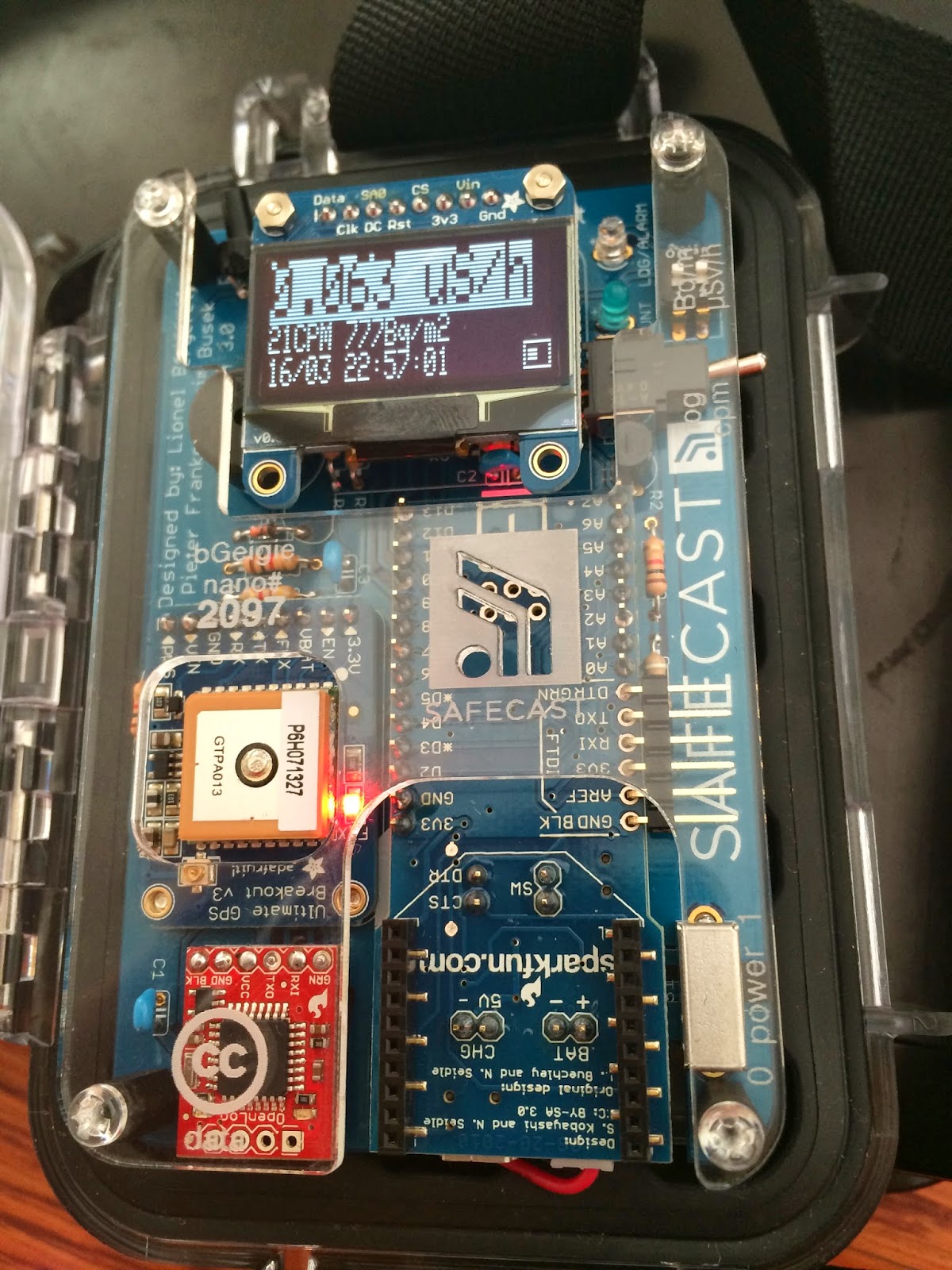
They have gone through several iterations/generations of monitors and the latest, the Nano bGeigie, won the Japanese "Good Design Award" in 2013. It is available only as a kit, so I attended their workshop on Sunday and built one. My first electrical soldering experience since ... high school? Middle school? In any event, it works!
One of the great things about building a kit is that you actually have a great sense of what the components are and now they work together.




They have accomplished a lot, to the point where the Japan Post attached Safecast radiation monitors to all the postal delivery motorbikes in several Fukushima cities for a year.
They show that, in fact, radiation levels have declined quite quickly in much of the area affected by the Fukushima accident. On the other hand, the government fixed monitoring stations overstate some of the reduction, since they have been placed in locations such as schoolyards, parks and in front of train stations that were the highest priority for clean up. You can see the Safecast maps here.
In the wake of the tsunami and nuclear disaster, the first issue was lack of availability of monitoring equipment. So Safecast designed its own monitors, which log data including GPS and timestamp information, and which is uploaded to their database. They now have over 15 million monitoring data points.
They have gone through several iterations/generations of monitors and the latest, the Nano bGeigie, won the Japanese "Good Design Award" in 2013. It is available only as a kit, so I attended their workshop on Sunday and built one. My first electrical soldering experience since ... high school? Middle school? In any event, it works!
One of the great things about building a kit is that you actually have a great sense of what the components are and now they work together.
Subscribe to:
Posts (Atom)